
A Practical, Science-Based Map for Understanding Regulation, Healing, and Growth
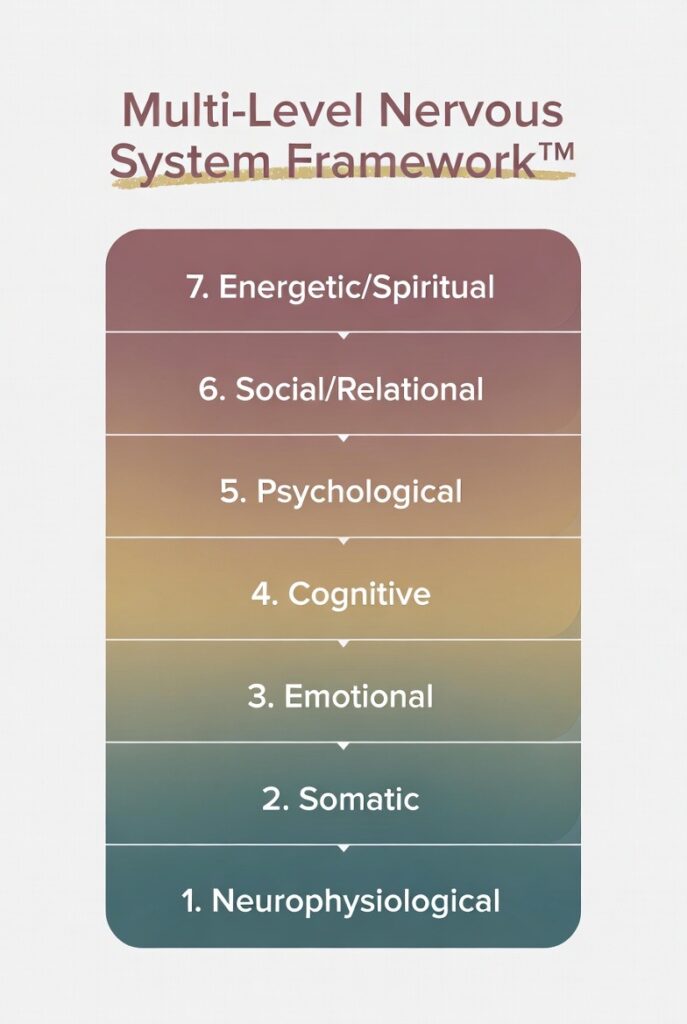
The Multi-Level Nervous System Framework™ is an integrative organising map that brings together well-established findings from neuroscience, trauma research, attachment theory, somatic psychology, and existential psychology into seven interacting domains:
- Neurophysiological Level – the foundation of bodily regulation and autonomic function
- Somatic Level – how sensations, posture, and movement express internal states
- Emotional Level – how feelings arise, move, or become blocked
- Cognitive Level – thought patterns, perception, and meaning-making
- Psychological Level – schemas, identity, and internal working models
- Social/Relational Level – co-regulation, attachment, and interpersonal safety
- Transpersonal/Existential – values, vitality, meaning, purpose, and connection beyond the self
It is a clinically useful synthesis—rooted especially in polyvagal theory (Porges), trauma neuroscience (Van der Kolk, Schore, Levine), attachment research (Bowlby, Cassidy, Johnson), affective science (Panksepp, Barrett), and schema/parts work (Young, Fisher, Schwartz)—designed to answer one practical question that practitioners and clients face every day:
“At this exact moment, which regulatory system is most driving the pattern—and what kind of support will actually help right now?”
Why This Framework Actually Helps People (and Why It Matters)
1. It answers the “Why don’t I change even when I understand?” problem
Most of us have had the experience of intellectually knowing why we do something—yet the body still freezes, the anger still explodes, or the old relationship pattern repeats. This framework shows why: insight lives at the cognitive/psychological levels, but if the neurophysiological or somatic systems are in survival mode (sympathetic activation or dorsal-vagal shutdown), the prefrontal cortex literally goes offline. You can’t “think” your way out until the lower levels feel safe enough to come back online. → Result: people stop blaming themselves for “lack of willpower” and learn which practices actually rebuild capacity.
2. It makes sense of why the same person needs different tools at different times
One week, journaling calms you. Another week, the same practice feels agitating or numbing. The framework explains this clearly: under moderate stress you may have enough ventral-vagal tone to use top-down strategies (journaling, reframing). Under higher stress or triggering, the system drops into fight/flight or collapse, and only bottom-up, body-first approaches restore regulation.
3. It shortens the trial-and-error phase of therapy and coaching
Instead of cycling through techniques hoping something sticks, you can quickly assess:
- Is the person in neuroceptive threat? → Start with physiological safety and co-regulation.
- Is the body holding incomplete defense responses? → Use somatic completion (Ogden, Levine).
- Are emotions accessible but overwhelming? → Build naming and toleration skills.
- Is the narrative self coherent but relationally reenacting old patterns? → Work relationally or with parts/schemas.
- Is there existential despair once basic safety is restored? → Move into meaning and values work. → Therapy becomes phased, logical, and far more efficient.
4. It dramatically improves communication between practitioner and client
When a client says “I know I’m safe but I still feel terrified,” both parties can now point to the same map: “Yes—your thinking brain (cognitive level) knows you’re safe, but your neurophysiology hasn’t caught up yet. Let’s resource the body first.” This shared language reduces shame, builds collaboration, and speeds progress.
5. It helps couples and groups understand each other
One partner may be in sympathetic mobilization (“Why are you shutting down?”) while the other is in dorsal-vagal collapse (“I feel paralyzed”). Without a map, this looks like rejection or laziness. With the framework, it’s recognizable as two different autonomic states trying to find co-regulation. → Conflict de-escalates faster; empathy increases.
6. It gives people a realistic, hopeful path toward “post-traumatic growth”
Trauma fragments the system across all seven levels. Healing is not about erasing the past—it’s about re-integrating the fragments. The framework shows the sequence most supported by research:
- Establish neurophysiological safety
- Reconnect with the body
- Process emotion
- Update beliefs and identity
- Repair relationships
- Reclaim meaning and purpose People can see where they are on the map and what realistic next step looks like.
In short: Why this framework matters
It turns the overwhelming complexity of being human into something organized and navigable—without oversimplifying or pathologizing anyone.
It gives individuals a way to understand themselves with compassion instead of self-criticism. It gives practitioners a reliable compass instead of a toolbox they throw at the wall hoping something sticks. And it gives everyone—therapists, coaches, educators, partners, parents—a shared language for the most important thing in life: helping ourselves and each other feel safer, more connected, and more alive.
© 2025 Jieying (Allie) Xie
The Multi-Level Nervous System Framework & Training™ is a proprietary system developed by Jieying (Allie) Xie.
All materials, methods, and terminology are protected under copyright and trademark law.
Reproduction or adaptation without written consent is prohibited.